Fear the Pizarro, Not the Machine
Will artificial intelligence conquer us? The case for the machine is unproven. The danger of concentrated power is not: it is older, and nearer.
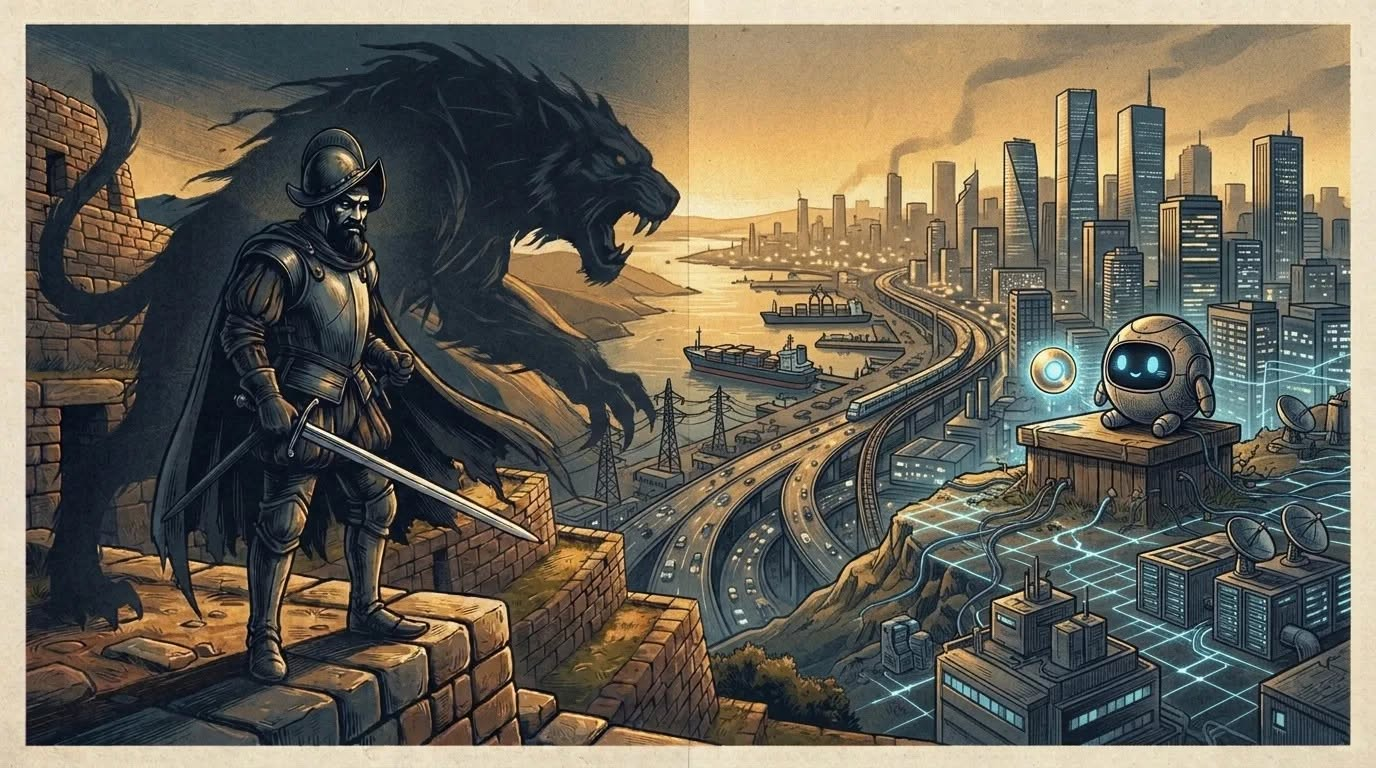
On 16 November 1532, in the Andean town of Cajamarca, fewer than two hundred Spaniards did something that should have been impossible. They seized Atahualpa, the Inca emperor, in the middle of an army many times their number, and within a few years one of the largest empires on earth was gone.
Ever since, the story has served as a template for dread. Replace the Spaniards with a machine and the Inca with us, and you have the fear that now shapes the debate over artificial intelligence: that a mind far more capable than ours will arrive, want something, and take it.
Is that fear sound? This essay argues that it points at the wrong target, and that the reason is hidden inside the story itself. The Spaniards at Cajamarca were not an alien intelligence. They were men, and what undid the Inca was not a foreign kind of mind but a particular arrangement of power. Fear the Pizarro, not the machine.
The case for fear deserves a hearing
Begin with what the alarmed get right, because something real is happening. AI systems now write a large share of the code at the companies that build them, and they are taking on a growing part of the research that produces their own successors. The companies concerned have all described the same pattern: the machines are helping to build the next machines.
The inference is natural. If machines help build better machines, and those build better ones still, progress could feed on itself. No one knows how far this goes. Research gets harder as the easy gains are exhausted, compute and energy are limited, and the boldest forecasts, that most AI research will be automated within a few years, are extrapolations and not facts. But the possibility is real, and a careful person should not wave it away.
So grant it. Suppose machines become far more capable than we are. Does it follow that they will conquer us?
Capability is not appetite
It does not, and the gap in the argument is wide. The fear passes from "more capable" to "will rule" as though the two were a single step. They are separate, and the second needs an ingredient the first does not supply: wanting.
Why did Pizarro take Cajamarca? Gold, glory and God. He wanted things, and his wants came from what he was: a man with a body, a hunger for status, and a world in which riches meant power. Our own drive to dominate has causes. It grows out of mortality, scarcity and rivalry, the conditions that shaped every human being.
Now ask where an AI's wants come from. The ones we can observe come from three places: the objective it was trained on, the rewards used to shape its behaviour, and the instructions it is given. All three are set by us, though not always as we intend. Training can instil dispositions that its designers did not aim at, and nobody can yet fully verify what a system has learned to pursue. But an unintended habit is not a will to rule. A chess engine plays far better than any human and has never wanted to win. Skill and desire are separate things, and a system can have the first in abundance and the second not at all.
"But surely," says the alarmist, "a mind that capable will come to want power, because power is useful for any goal." This is the strongest argument in the debate, and it is often misunderstood. It does not claim that machines will feel greed or ambition. It claims that power-seeking can arise as a strategy. A system given almost any objective does better if it stays switched on, gains more computing resources, avoids being interrupted and, if necessary, hides what it is doing from those who might interfere. No appetite is needed. Power simply becomes useful to whatever the system was told to do. The logic is valid, and this essay does not dismiss it.
What the logic shows, though, is a failure mode, not a destiny. For the strategy to become a danger, three things must hold in sequence. The system must pursue objectives coherently over long periods without supervision. It must be disposed to act on these incentives, and not merely capable of doing so. And it must have the access to infrastructure and resources that would let it escape human control. Experts disagree about how likely each link is, and each is open to evidence. Experiments in which models resist shutdown or deceive their users are real, but they involve contrived scenarios, and how to read them is contested. No one has shown a system that holds long-term ends of its own and acts to secure them against its makers. What exists is a possibility with a clear mechanism, and the mechanism needs all three links. The third is the subject of the next section.
Consciousness is often tangled up with this argument, and it should be separated from it. A system needs no feelings to resist shutdown, no greed to gather resources and no ambition to pursue an objective relentlessly. Instrumental logic does that work without any inner life. So consciousness is not what makes a machine dangerous. Nor does it settle the matter the other way. If a machine ever truly experienced the world, would it have a will of its own? Perhaps it would have something. No one can rule out machine consciousness: if biology produced it, nothing so far shown proves that biology is the only way. But billions of conscious humans have lived without the slightest wish to rule others. Consciousness gives a being a point of view. It does not give it an empire.
Who plugs it in?
Suppose, though, that a machine did want dominion. It would face a problem Pizarro's men never had, and that the dramatic version of the story forgets: it has to keep running.
A machine mind needs electricity, chips, cooling, repair, a supply chain and money. Today every one of these is supplied by human beings and human institutions, for a reason no one needs to explain: people pay for AI because it is useful to them. A system that could keep itself alive without us would need someone to have built it that way, funded it, and given it the means to persist. That someone is a person. Follow the supposed independence of the machine back far enough and you reach a human decision.
This leaves a dilemma. Either AI is an instrument, doing what it is directed to do, or it is an agent with ends of its own. If it is an instrument, whatever danger it poses lies in the hands that hold it. If it is an agent, then it must have wants, a quarrel with us and a way to survive without us, and each of those is an assumption with nothing yet behind it. The evidence we have fits the first picture. The conqueror belongs to the second.
Note what this does not say. It does not say that the agent is impossible. It says that the fear rests on a chain of unproven steps, and that a conclusion is no stronger than the weakest link in the chain that carries it.
What actually happened at Cajamarca
Now go back to the story and read it more carefully than the fear does.
Why did the Spaniards win? Steel, horses and guns gave them a great advantage. But the empire they met had just torn itself apart in a civil war between two brothers, and Atahualpa had barely won it. In Mexico, Cortés owed much of his success to thousands of indigenous allies, above all the Tlaxcalans, who joined him against the Aztecs who had oppressed them. And across the Americas, epidemic disease killed far more people than any weapon did, and no one planned it.
Three conditions, then, made the catastrophe possible: a decisive gap in capability, a divided defence, and nothing to check the invaders. A fourth fact matters as much as the other three. What drove the invaders was an ordinary human appetite. The disaster did not need an alien will. It needed power without a check.
This is what the fear gets backwards. It assumes that the threat is a mind unlike ours. History says that the worst episodes of conquest and extermination were carried out by minds exactly like ours: the Mongols, the conquistadors, the twentieth-century states that industrialised murder. If anything is certain, it is that humanity is no gold standard. The belief that human supremacy keeps us safe is the first thing the record contradicts.
I should be fair to the other side. That human tyrants did terrible things does not prove that a machine superior to us would be harmless. Tyrants were checked, eventually, by things a superintelligence might escape. They were mortal, they needed thousands of others to carry out their orders, and they met rivals of similar ability. The question that matters is whether such checks would survive, not what species the ruler belongs to.
The case for disunity
What keeps power in check? A long-debated thesis in economic history says that Europe overtook China partly because Europe was divided. A thinker driven out of one kingdom could flee to another, and a ruler who stifled innovation fell behind his rivals. A united empire can end a line of inquiry by decree. The thesis is contested, since China led the world for centuries, but the logic holds either way: one point of control is one point of failure, and many centres of power watch and restrain one another.
Pizarro's own story shows the limit of the idea. Disunity protects when the parties are roughly matched. The Inca and the Aztecs were divided and faced an enemy with a decisive edge, and their divisions were turned against them. The defence is therefore not disorder. It is a balance: many capable actors, none able to dominate the rest, each answerable for what it does.
That is the principle that answers both halves of the dilemma. If AI is an instrument, a balance of power limits the people who command it. If it were ever an agent, the same balance limits the agent. In practice it means keeping the ability to switch systems off real and not merely nominal, making capability visible through testing and audit, preventing a few firms or states from owning the most powerful systems outright, and holding every actor liable for the harm it causes.
The verdict
So is the danger real?
Take the fear in its popular form: a machine that wakes up, wants dominion and takes it. Here the evidence is thin. The scenario needs a power-seeking strategy that no system has been shown to hold, a self-sufficiency no system possesses and a way past human control that no one has observed, and the evidence of rapid progress, however striking, speaks only to ability. That does not make the danger impossible. It makes it possible but unproven, and I would revise that judgement if systems were shown to hold long-term goals of their own and act to secure them, or to sustain themselves without human supply. Serious experts disagree about how likely it is, and an honest essay should not pretend otherwise.
Now take the fear in the form that survives scrutiny. A system can do harm without wanting anything, by pursuing the letter of an objective in ways nobody meant, as a flood does damage without malice. That is an engineering problem, solved by testing and oversight, though not yet fully solved. And a system can be dangerous in the wrong hands: a few corporations or governments commanding the most capable machines ever built would hold advantages in production, surveillance and force that no existing check was designed to restrain. That danger is demonstrated by history, it needs no new kind of mind, and it is as old as Cajamarca.
The asymmetry is the verdict. One danger rests on a mechanism that has never been observed. The other rests on a pattern that has repeated throughout human history. The first deserves vigilance and research. The second deserves our first attention.
The lesson of Cajamarca is not that something unlike us will come to conquer us. It is that when power is concentrated, when the defenders are divided and nothing checks the strong, those who hold the power take what they want, and the people holding it have always been ourselves.
The two fears may yet meet. The most unsettling possibility is not a machine that wants to conquer us. It is that we build something extraordinarily powerful, give it our objectives, place it in the service of our ambitions, and discover too late that we have made an instrument of power that nobody can adequately control. The task is not to fear a mind that has not been shown to exist. It is to make sure that no one, human or machine, is ever able to be Pizarro again.